|
|
|
|
|
|
|
|
|
Richard Caton Woodville Military Art
Military Prints  Richard Caton Woodville Richard Caton Woodville |
[UP] - Lady Elizabeth Butler - Ernest Crofts - Alphonse de Neuville - Horace Vernet - J B Edouard Detaille - Jean Louis Ernest Meissonnier - Richard Caton Woodville - James P Beadle - William Barnes Wollen - Thomas Jones Barker - Jacques Louis David - Robert Gibb - Robert Hillingford - John Charlton - Richard Simkin - Richard Knotel - Carl Rochling - Sir John Gilbert - Carl Vernet - Modern Artists - David Rowlands - Terence Cuneo - Antique Prints - Gifts and Books |
|
Historical military art by Victorian military artist Richard Caton Woodville. Woodville's superb range of paintings covered Napoleonic, Crimea, Afghan, Boer war and Sudan campaigns. This prolific artist range of military prints published by Cranston Fine Arts.
Artist Information: WOODVILLE, Richard Caton
Born London 1856; died there 1927. |
| Navigation | |
| Page 2 of 4 | Previous .. Page 2 .. Next |
|
|
|
|
|
|
|
|
|
|
|
|
|
|
|
|
|
|
|
|
|
| Navigation | |
| Page 2 of 4 | Previous .. Page 2 .. Next |
| Text for the above items : |
Relief of the Light Brigade by Richard Caton Woodville. Depicting the Light Brigade at the moment of reaching the Russian guns. Shown are the 11th Hussars and the 17th Lancers. The all time classic image of the disastrous Charge of the Light Brigade which included the 17th lancers, who lead the charge. Lord Cardigan is shown on the left, dressed in his 11th Hussars uniform. The Light Brigade were being kept in reserve, after the successful charge of the heavy brigade, but the slow advance of the British Infantry to take advantage of the heavy brigades success had given the Russian forces time to take away Artillery pieces from captured redoubts. Raglan, after seeing this ordered the light brigade to advance rapidly to the front, follow the enemy and try to prevent the enemy carrying away the guns. This message taken by Captain Nolan, to Lord Lucan, the cavalry Commander. One of the Officers of Raglans Staff, urged Lucan, who could only see the main Russian Artillery position at the head of a valley. Lord Lucan rode over to Cardigan and ordered him to attack these guns. So the Light Brigade charged these Russian guns, and not the guns being taken away by Russian forces from the redoubts. The carnage was great, from the 673 men who started the charge, 113 men were killed and many others wounded. The Light Brigade was made up of the 4th and 13th Light Dragoons, 8th and 11th Hussars and the 17th Lancers. A spectating French Officer General Pierre Bosquet proclaimed - It is magnificent but it is not war. |
The Charge of the Light Brigade by Richard Caton Woodville. The all time classic image of the disastrous Charge of the Light Brigade which included the 17th lancers, who lead the charge. |
My Brave Irish by Richard Caton Woodville The last charge on Pieters Hill, 27th February 1900 by the 2nd Irish Fusiliers, assisted by the 2nd Royal Dublin Fusiliers. |
Honourable Artillery Company by Richard Caton Woodville. No text for this item |
The Cameronians by Richard Caton Woodville No text for this item |
Fitz-Stephen Burns His Boats, 1169 by Richard Caton Woodville. (B) In Response to King Dermots solicitations, Strongbow sent Fitz-Stephen to Ireland with an advance guard while he completed his own preparations. The Normans landed near Wexford, were joined by Dermot and marched with him to storm the city. Being at first severely repulsed, Fitz-Stephen determined to leave himself no retreat, led his men to the shore, where they set fire to their transports. Upon their return the garrison displayed a flag of truce and Wexford was surrendered without further bloodshed. |
Prince Alberts Somerset Light Infantry by Richard Caton Woodville No text for this item |
Lord Roberts Entry into Pretoria by Richard Caton Woodville. No text for this item |
Up Guards and at Them by Richard Caton Woodville. Wellington orders the Grenadier Guards to advance during the closing stages of the Battle of Waterloo. |
Army Service Corps by Richard Caton Woodville. No text for this item |
All that was Left of Them by Richard Caton Woodville. The Light Brigade had 195 mounted survivors, leaving 113 dead and 134 wounded with 231 unhorsed men. After the charge of the Light Brigade, the Roll is shown being carried out. |
92nd Highlanders at the Battle of Kandahar by Richard Caton Woodville. The painting depicts the 92nd Highlanders (Gordon Highlanders) routing Ayub Khan tribesmen, on 31st August 1880, who had earlier on 26th July beaten the British at the battle of Maiwand and was now besieging the remainder of Primroses division in the citadel of Kandahar. Roberts with a force of 10,000 men (Gordon Highlanders, 60th Rifles, 72nd Highlanders, Sixth Gurka and Punjabi Infantry) marched out of Kabul to relieve Kandahar which was 300 miles away. The epic Battle of Kandahar made Roberts one of the great Victorian military heroes. |
Royal Army Medical Corps by Richard Caton Woodville. No text for this item |
The 5th Lancers Re-enter Mons, November 1918 by Richard Caton Woodville. The 5th Lancers (attached to the Canadian Corps) were the first British troops to re-enter Mons, just as they had been the last to leave Mons in August 1914. Very few of the troopers who left Mons in 1914 were there to re-enter in 1918. |
All That Was Left of Them by Richard Caton Woodville Illustrates the scene at Modderfontein Farm where a squadron of the 17th lancers were pinned down by a large Boer force, and fought to the finish. Modderfontein Farm in the Eastern Cape, about 10 miles from Tarkastad, was the the battle on the 17th September 1901, between the 17th Lancers who had camped there, and General Jan Christiaan Smut's Boer Commandos. C squadron of the 17th Lancers lost 3 Officers and 35 troopers, a single action in which the 17th Lancers lost more men in one day than any other day, inclduing that of the infamous charge of the Light Brigade. Also killed that day were three gunners from the Royal Garrison Artillery. Another account states that out of 130 men, 29 were killed and 41 wounded. All Officers had been killed or wounded. |
Charge of the Life Guards by Richard Caton Woodville 1st Life Guards charge against the 12th regiment of Cuirassiers during the battle of waterloo. |
The Manchester Regiment by Richard Caton Woodville. No text for this item |
Burning the Eagles on the Retreat From Moscow by Richard Caton Woodville. Showing the burning of the Eagles and Standards with Napoleon and staff looking on before crossing the Ber and out of Russia with the remains of his once grand army. |
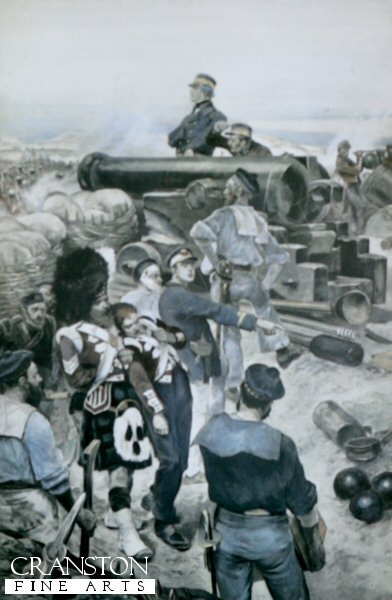
Sebastopol by Richard Caton Woodville. Royal Navy guns taken from their ships and used at Sebastopol. By mid-October 1854, the Allies had some 120 guns ready to use against Sevastopol while the defending Russians had over 300 guns to defend against attacking infantry. The Russians opened the artillery barrage on the 17th of October 1854 and destroyed the French magazine, which put their guns out of action. But the British guns began to fire and quickly blew the magazines in the Malakoff redoubt, killing Admiral Kornilov, and silencing most of the Russian guns, weakening the Sebastopol defences and providing an excellent chance for a British and French assault on the City of Sebastopol, which was not taken. |
The Zulu War, Battle of Ulundi, The Final Rush of the Zulus Against the British Squares by Richard Caton Woodville. The marks shown on image are due to the item being rolled and certainly most will disappear when framed. A superb Zulu War piece, an attractive addition to any collection. |
Saving the Guns at the Battle of Maiwand by Richard Caton Woodville. (P) No text for this item |
|
Contact Details |
|
Sign Up To Our Newsletter!
This website is owned by Cranston Fine Arts. Torwood House, Torwoodhill Road, Rhu, Helensburgh, Scotland, G848LE Contact: Tel: (+44) (0) 1436 820269. Email: cranstonorders -at- outlook.com
|
 |